
Every website needs two foundational things: hosting and a domain name. While hosting costs can vary dramatically depending on the platform and infrastructure, domain costs are one of the few truly fixed annual expenses every website owner will encounter.
Whether you are launching a personal portfolio, an e-commerce brand, or a full business website, understanding how domain pricing works is important for budgeting long-term website costs properly.
What Is a Domain Name?
A domain name is the address users type into a browser to access your website — such as yourbusiness.com.
Instead of forcing users to remember an IP address, domains create a recognizable, branded destination online. For businesses, a domain is not just technical infrastructure. It is part of the brand itself.
A good domain should typically be:
- Short and memorable
- Easy to spell
- Relevant to the brand or industry
- Professional and trustworthy
- Easy to say verbally
For most businesses, the domain becomes a permanent part of their identity, which is why it should be viewed as a recurring operational expense rather than a one-time purchase.
Average Domain Cost (Annually)
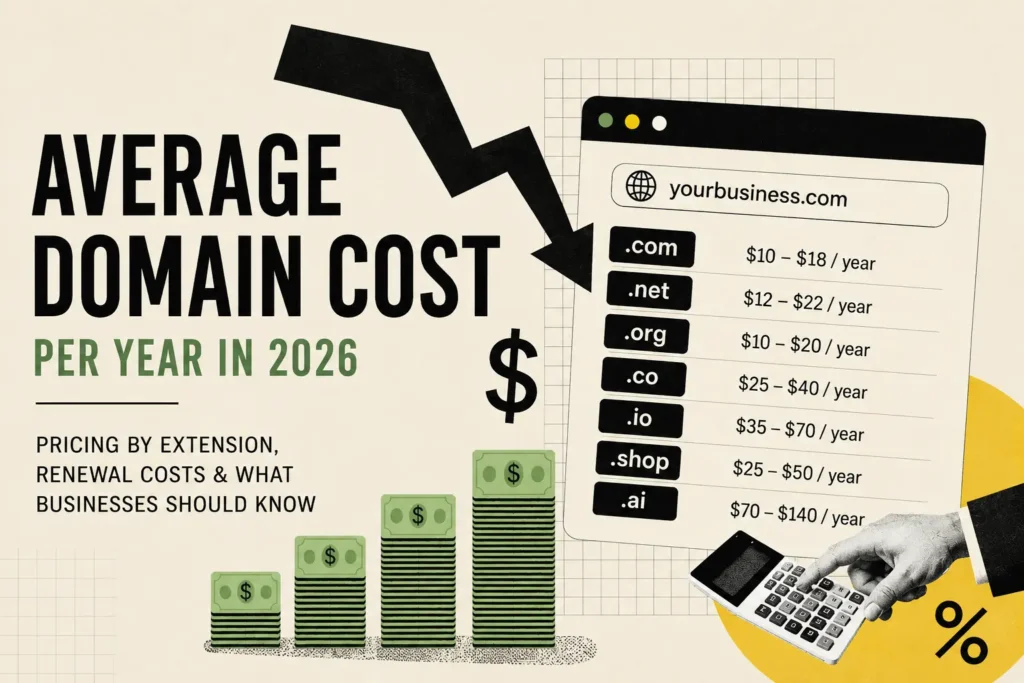
In 2026, the average annual cost for a standard domain typically falls between $10–$25 per year for common extensions.
However, pricing varies depending on:
- Domain extension
- Registrar
- Promotional pricing
- Demand and popularity
- Renewal rates
- Premium keyword value
Here is a general breakdown of common domain extension pricing:
| Domain Extension | Typical Annual Cost |
|---|---|
.com | $10–$18 |
.net | $12–$22 |
.org | $10–$20 |
.co | $25–$40 |
.io | $35–$70 |
.studio | $20–$45 |
.shop | $25–$50 |
.store | $30–$60 |
.ai | $70–$140 |
.dev | $12–$25 |
While many registrars advertise low first-year promotions, renewal pricing is what matters long term. A domain listed for $1.99 initially may renew at $20+ annually after the first year.
This is where many businesses unintentionally underestimate their ongoing website costs.
Why .com Still Dominates
Despite the rise of newer extensions, .com remains the most trusted and universally recognized option.
There are several reasons for this:
- Strong consumer familiarity
- Higher perceived credibility
- Easier recall
- Better verbal recognition
- Lower likelihood of traffic confusion
For most businesses, .com is still the safest long-term investment if the domain is available.
That said, alternative extensions have become increasingly common for startups, creative brands, and niche industries.
Examples:
.studiofor creative agencies.iofor tech companies.storeor.shopfor e-commerce.aifor AI-focused businesses.cofor modern startup branding
The extension itself does not determine SEO performance directly, but trust and click-through behavior can absolutely influence user engagement over time.
Premium Domains Can Cost Significantly More
Not all domains are priced equally.
Highly desirable domain names are often categorized as “premium domains,” meaning the registrar or current owner assigns additional market value to the name itself.
Examples:
coffee.comdesign.iojewelry.store
Premium domains can range anywhere from:
- A few hundred dollars
- To several thousand
- Or even millions in rare cases
For most small businesses, a standard branded domain is usually the smarter financial decision early on.
Strong branding almost always matters more than owning an ultra-expensive keyword domain.
Domain Privacy and Additional Costs
Some registrars include additional services in the annual price, while others charge separately.
Potential add-on costs may include:
- WHOIS privacy protection
- Business email services
- DNS management
- Security protection
- Domain forwarding
- SSL certificates
Fortunately, many modern registrars now include basic privacy protection for free.
Still, it is important to compare renewal pricing and included features — not just the advertised introductory price.
Domains Are One of the Few Truly Fixed Website Expenses
One important distinction many businesses overlook:
A domain is unavoidable.
Regardless of whether a website is built on:
- WordPress
- Shopify
- Squarespace
- Wix
- Framer
- Webflow
- Custom infrastructure
…the domain remains a recurring annual expense.
Unlike platform subscriptions, plugin licensing, or scalable hosting infrastructure, domain renewals are relatively stable and predictable.
This makes domain costs one of the easiest website expenses to budget for long term.
For many businesses:
- The domain may cost only $10–$20 annually
- While the platform itself could cost hundreds or thousands per year
This is why platform selection often has a far greater impact on long-term operating costs than the domain itself.
Choosing the Right Registrar
A registrar is the company you purchase and manage your domain through.
Some of the most commonly used registrars include:
- Cloudflare
- Namecheap
- Porkbun
- GoDaddy
- Google Domains (migrated into Squarespace Domains)
When selecting a registrar, businesses should compare:
- Renewal pricing
- Ease of DNS management
- Transfer policies
- Included privacy protection
- Support quality
- Overall transparency
Low introductory pricing is rarely the full story.
How Flexify Labs Helps Reduce Long-Term Domain Costs
At Flexify Labs, domain registration is treated as part of the larger long-term cost strategy behind building and maintaining a website.
Many businesses focus only on the initial launch cost of a website, but recurring expenses add up over time — especially when domains are purchased through platforms with inflated renewal pricing or bundled markups.
Flexify Labs will help clients:
- Compare registrar pricing before purchase
- Avoid misleading first-year promotional pricing
- Identify lower long-term renewal costs
- Choose reliable domain extensions based on business goals
- Avoid unnecessary premium domain markups
- Configure domains independently from restrictive website builders
In many cases, businesses unknowingly pay significantly more than necessary simply because their domain is tied directly into a closed website platform.
By separating domain ownership from the website platform itself, businesses typically gain:
- Greater pricing transparency
- Easier portability
- Better long-term control
- Lower annual operating costs
For most projects, Flexify Labs recommends registrars that balance:
- Competitive renewal pricing
- Free privacy protection
- Strong DNS management
- Transparent pricing structures
- Reliable long-term ownership control
While domain costs are usually one of the smaller website expenses overall, optimizing these recurring costs contributes to a more sustainable and scalable web presence over time — especially for businesses managing multiple domains, brands, or future expansion plans.
Final Thoughts
Domain costs are relatively small compared to the broader cost of operating a website, but they remain a permanent annual expense every business should account for.
For most businesses, the ideal approach is simple:
- Secure a clean, memorable domain early
- Prioritize long-term renewal pricing
- Avoid overpaying for unnecessary premium domains
- Treat the domain as foundational business infrastructure
A well-chosen domain can last for decades. In many cases, it becomes one of the most valuable digital assets a business owns.
Planning a Website for Your Business?
For businesses planning a new website or restructuring an existing one, choosing the right domain and infrastructure early can help avoid unnecessary long-term costs and platform limitations. Flexify Labs helps businesses build scalable websites with full ownership and long-term flexibility in mind.