
A TikTok reaches 100,000 views. An Instagram Reel starts bringing in new followers every day. A YouTube channel gains momentum after months of consistency. A podcast episode gets shared by a larger creator. An Etsy shop begins receiving more orders than expected.
For creators, side hustlers, personal brands, and small businesses, these moments feel like success—and they are. But this is where a new challenge begins.
Most advice surrounding the idea of social media replacing a website is misguided. It often treats websites and social platforms as competing tools, making businesses think they can choose one or the other. In reality, the most successful brands rarely make that choice.
Instead, they understand that social media and websites serve entirely different purposes.
Social media helps people discover you. A website helps them take the next step.
As your audience grows, that distinction becomes increasingly important.
The challenge isn’t getting attention online. Social media has made that more accessible than ever before. The real challenge is knowing what to do with that attention once it arrives.
Website vs Social Media: Why This Debate Misses the Point
The internet is full of debates about whether websites are still necessary.
After all, social media has become incredibly powerful. Creators can build entire careers on YouTube. Artists can sell work through Instagram. Side hustles can gain traction through TikTok. Local businesses can connect directly with customers on Facebook.
It’s easy to look at these success stories and conclude that websites are becoming less relevant. But this perspective overlooks an important reality. Websites and social media serve a different purpose.
Social platforms are designed around discovery. Their job is to help people find content, businesses, and creators they may never have encountered otherwise.
Websites serve a different role. They provide structure, context, credibility, and a place for deeper engagement.
The real website vs social media debate isn’t about which tool is better for your business. It’s about understanding what each tool is designed to accomplish.
Social Media Is Where Growth Begins
There has never been a better time to build an audience online.
A creator can publish a video and reach thousands of people without spending money on advertising. A freelancer can establish authority through content. A podcaster can build a loyal following through consistent episodes. A small business can attract customers through engaging social media posts.
This accessibility has transformed how businesses grow.
Social media excels at:
- Building awareness
- Growing audiences
- Creating engagement
- Starting conversations
- Showcasing expertise
- Generating attention
For many businesses, social media becomes the engine that drives growth.
The challenge is that attention alone rarely creates sustainable growth.
Eventually, growth creates new needs.
What Happens When Your Audience Starts Growing
One of the biggest misconceptions about growth is that it solves problems.
In reality, growth often reveals them.
As audiences expand, people begin looking for more information. They want to know who you are, what you offer, whether they can trust you, and how they can work with you or buy from you.
At this stage, businesses often realize they need things such as:
- Product or service pages
- Portfolios and case studies
- Testimonials and reviews
- Email list signups
- Resource libraries
- Search engine visibility
- Inquiry and contact forms
These aren’t signs that social media has stopped working.
They’re signs that social media is working so well that your audience needs a deeper experience than a social profile can provide.
The attention you’ve worked hard to earn now needs somewhere to go.
The Difference Between Attention and Assets
The clearest way to understand the difference is through a simple distinction:
Social media creates attention. Websites create assets.
A successful Instagram Reel may generate engagement for a few days. A viral TikTok may attract thousands of views. A YouTube video may perform well for months.
Eventually, however, newer content often replaces older content.
That’s simply how social platforms operate. Websites function differently.
Every page on a website becomes an asset that can continue creating value long after it is published.
For example:
- A service page can generate inquiries for years.
- A blog article can attract search traffic through Google.
- A portfolio can help convert visitors into clients.
- A product page can continue producing sales.
- A resource guide can establish authority in a niche.
This is where websites become particularly powerful.
Social media creates momentum. A website gives that momentum somewhere to accumulate.
Over time, those assets begin working together. Articles attract visitors. Visitors join email lists. Subscribers become customers. Customers become advocates.
Instead of constantly chasing new attention, the business begins building something that compounds.
How People Actually Move From Discovery to Action
Modern customer journeys rarely happen on a single platform.
People move between platforms constantly before making decisions.
- A YouTube viewer may watch several videos before visiting a website.
- An Instagram follower may browse products before making a purchase.
- A podcast listener may visit a website to access resources and join an email list.
- A LinkedIn connection may review case studies before scheduling a consultation.
- A local customer may discover a business on social media and later search for it on Google.
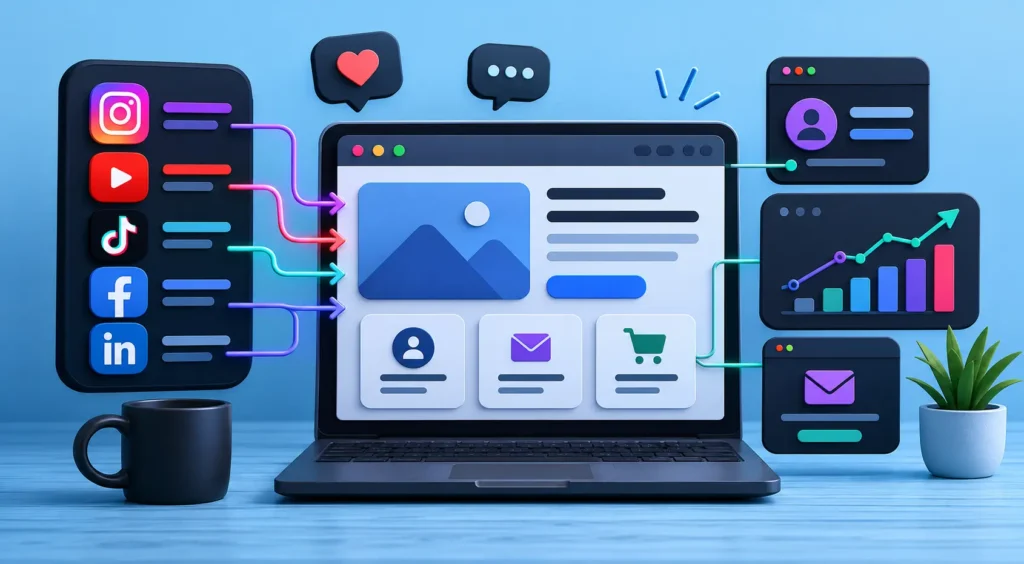
The path often looks something like this:
Instagram → Website → Product Purchase
YouTube → Website → Newsletter Signup
Podcast → Website → Resource Download
LinkedIn → Website → Consultation Request
Google Search → Website → Inquiry Form
In nearly every example, social media creates the introduction. While a professional website provides a deeper experience that helps someone take action.
This is why successful brands rarely choose between social media and websites.
Each serves a different role within the customer journey.
Why Creators, Podcasters, and Side Hustles Benefit Most
This conversation is especially important for creators because many of them begin entirely on social media.
A YouTuber can build an audience directly on YouTube.
A podcaster can distribute through Spotify and Apple Podcasts.
An artist can showcase work through Instagram.
A side hustle can start generating sales through TikTok.
At first, those platforms may be all that’s needed.
As growth continues, however, opportunities begin appearing that these platforms weren’t designed to support.
A creator may need:
- A media kit
- A sponsorship page
- A newsletter hub
- A digital storefront
- A resource library
A podcaster may benefit from:
- Episode archives
- Show notes
- Guest resources
- Sponsorship information
A freelancer may need:
- Service pages
- Case studies
- A professional portfolio
- Lead capture forms
In each case, the website becomes more than a digital brochure.
It becomes the central hub of the brand.
The place where everything connects.
Building a Foundation for Long-Term Growth
One of the biggest misconceptions about websites is that they need to be large, expensive projects.
Most don’t.
A simple website often provides everything needed to support growth:
- Homepage
- About page
- Products or services page
- Contact page
From there, additional resources, content, and functionality can be added over time.
The objective isn’t complexity.
The objective is creating a foundation that supports growth.
Without that foundation, every new piece of content starts and ends on a social platform.
With it, every piece of content contributes to something you own.
That difference becomes increasingly valuable as audiences grow.
How Flexify Labs Helps Businesses Grow Beyond Social Media
At Flexify Labs, we work with creators, side hustlers, personal brands, and small businesses that are ready to build on the momentum they’ve already created.
Many already have audiences, consistent content, and demand for what they offer. What they often need is a stronger foundation that supports momentum over the long term.
We help clients build websites designed around growth through strategic design, search engine optimization (SEO), content architecture, e-commerce functionality, and lead-generation systems.
Rather than treating websites vs social media as an either-or decision, we help businesses use both together.
Social media generates attention. A website helps transform that attention into a long-term business asset.
Final Thoughts
The “website vs social media” debate often assumes that one platform must replace the other.
But that’s not how growth works.
The most successful creators, side hustles, personal brands, and businesses don’t choose between social media and websites. They understand that each serves a different purpose.
Social media is often where growth begins.
A website is where that growth becomes sustainable.
As audiences expand, opportunities increase. Customers want more information. Prospects want reassurance. Followers want deeper engagement.
At some point, attention alone is no longer enough.
Social media creates momentum.
A website gives that momentum somewhere to accumulate.
And over time, that difference can become one of the most valuable assets a brand owns.