
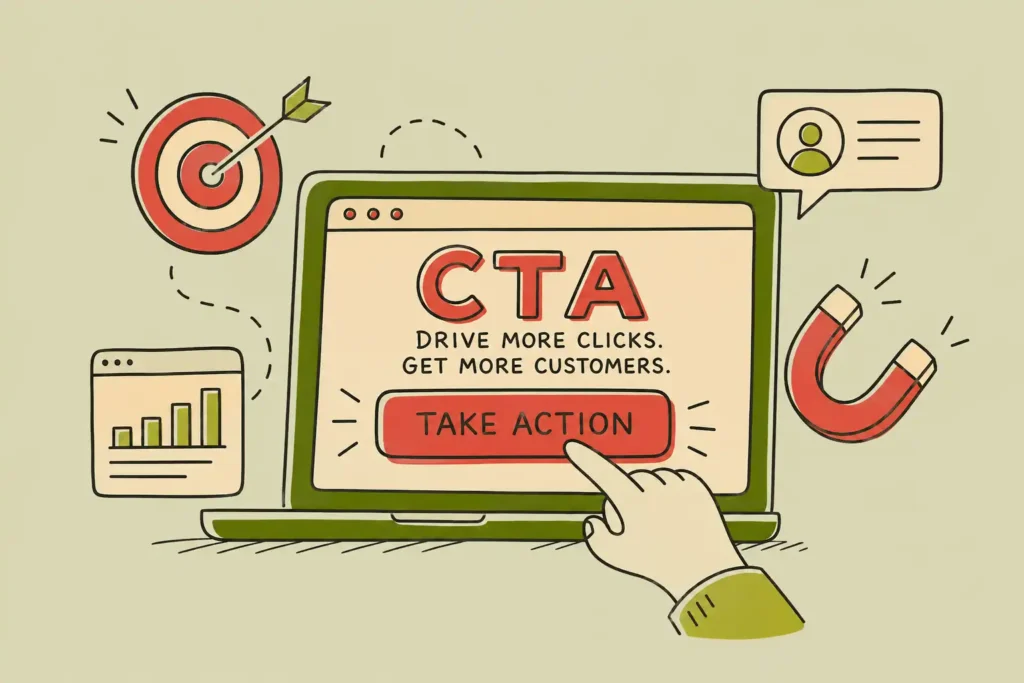
Most businesses spend significant time and money trying to attract more website traffic through SEO, advertising, social media, and content marketing. Yet many overlook one of the most influential factors affecting whether that traffic turns into leads, customers, or sales: the call to action (CTA). This article will illustrate how following CTA best practices can help improve conversion rates throughout your website.
A CTA is the point where a visitor decides whether to take the next step. It may be a button that says “Schedule a Consultation,” a form encouraging users to request a quote, or a prompt to download a guide. While seemingly simple, CTAs play a critical role in conversion rate optimization because they directly influence user behavior.
Research consistently shows that improving calls to action can generate meaningful increases in conversions without increasing website traffic. For small businesses, this often represents one of the highest-return improvements available.
What Is a Call to Action?
A call to action is any element that encourages a visitor to take a specific action.
Common examples include:
- Schedule a Consultation
- Request a Quote
- Get Started
- Download the Guide
- Call Now
- Add to Cart
Every website has a purpose. Whether that purpose is generating leads, selling products, booking appointments, or growing an email list, CTAs are the mechanism that moves visitors toward that goal.
Without a clear CTA, visitors are often left wondering what to do next. In many cases, they simply leave.
The Psychology Behind Effective CTAs
Successful CTAs are built around established principles of human behavior.
Decision Fatigue and Choice Overload
Psychologists have long studied how excessive choices affect decision-making. Research by psychologist Barry Schwartz, author of The Paradox of Choice, suggests that too many options can increase anxiety and reduce action.
This principle applies directly to websites.
When visitors encounter multiple competing actions—Contact Us, Learn More, Subscribe, View Services, Request a Quote, Read the Blog—they may choose none of them.
Strong conversion-focused pages typically emphasize one primary action and reduce unnecessary distractions.
Cognitive Fluency
People naturally prefer information that is easy to understand.
Researchers refer to this as cognitive fluency—the idea that information requiring less mental effort feels more trustworthy and approachable.
Compare these examples:
Clear CTA
- Schedule a Consultation
Complex CTA
- Initiate Your Strategic Discovery Process
The first option requires almost no interpretation. The second creates unnecessary friction.
Fogg Behavior Model
Behavior scientist B.J. Fogg’s research at Stanford introduced the Fogg Behavior Model, which proposes that behavior occurs when three elements are present simultaneously:
- Motivation
- Ability
- Prompt
A CTA serves as the prompt.
Even highly motivated visitors often fail to take action when a website fails to provide a clear next step.
Hick’s Law
Hick’s Law states that decision-making time increases as the number of choices increases.
This is one reason why dedicated landing pages frequently outperform cluttered pages. Reducing competing actions helps visitors make decisions more quickly.
Loss Aversion
Research in behavioral economics by Daniel Kahneman and Amos Tversky demonstrated that people are generally more motivated to avoid losses than achieve equivalent gains.
For example:
Generic CTA
- Learn About Website Audits
Loss-Oriented CTA
- Discover What’s Costing You Leads
The second example often creates greater urgency because it highlights a potential loss.
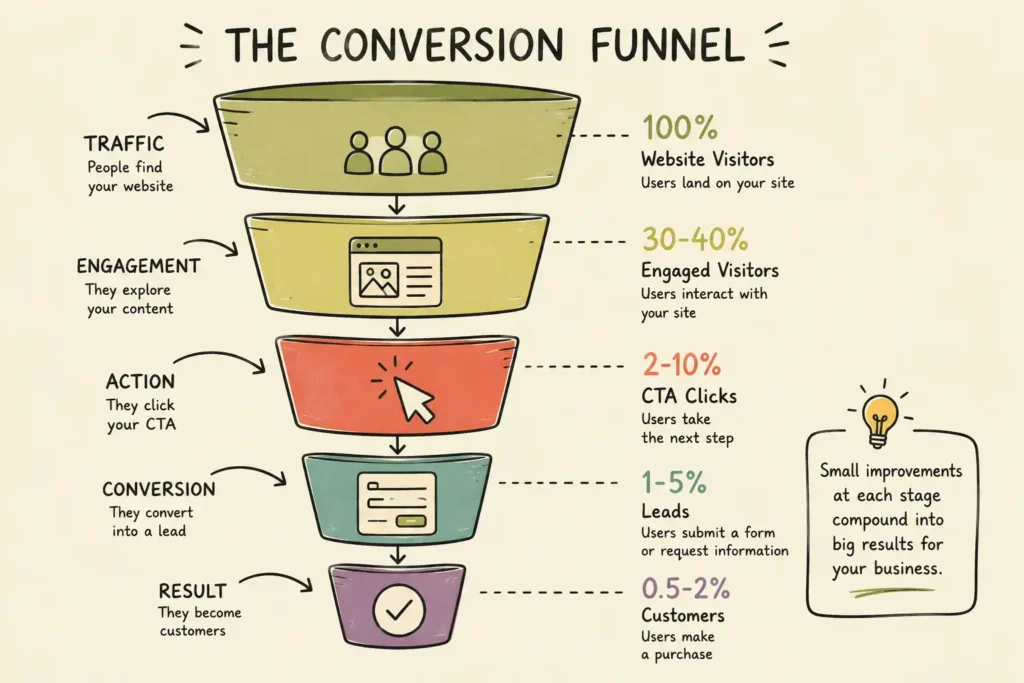
What the Research Says About CTA Performance
Calls to action are among the most frequently tested website elements in conversion rate optimization.
One of the most widely cited studies comes from HubSpot, which analyzed over 330,000 calls to action. Their findings showed that personalized CTAs converted 202% better than generic CTAs.
For example:
Generic
- Learn More
Personalized
- Get My Free Website Audit
The personalized version provides a clearer value proposition and feels more relevant to the visitor.
Research from conversion optimization firm CXL documented a case where a fitness company changed its CTA from:
- Get Your Membership
to:
- Find Your Gym & Get Membership
The revised CTA increased conversions by 68%.
The improvement occurred because the new CTA addressed a specific concern visitors had before committing—finding a convenient location.
The lesson is important: effective CTAs are not necessarily more persuasive. They are often more relevant.
Why Better CTAs Produce Better Business Outcomes
Improved CTAs can positively impact nearly every major website conversion goal.
Lead Generation
For service businesses, stronger CTAs often increase:
- Consultation requests
- Contact form submissions
- Quote requests
- Discovery calls
E-Commerce Sales
For online stores, optimized CTAs can improve:
- Add-to-cart rates
- Checkout completion
- Product page engagement
- Revenue per visitor
Email Marketing
Lead-generation CTAs frequently increase:
- Newsletter subscriptions
- Lead magnet downloads
- Webinar registrations
Local Business Conversions
For local businesses, CTA improvements can generate:
- More phone calls
- More appointment bookings
- Increased store visits
Even modest improvements can create substantial business impact over time.
Wondering How Your CTAs are Performing?
Get a clear picture of your website’s conversion strengths, weaknesses, and growth opportunities.
CTA Best Practices – Design
While messaging matters, design also plays a significant role in CTA performance.
Contrast Matters More Than Color
One of the most common questions in website design is:
“What color converts best?”
Research and A/B testing across the conversion optimization industry suggest there is no universally superior color.
What matters most is contrast.
A CTA should stand out clearly from surrounding content. A blue button may outperform an orange button on one website, while the opposite may occur elsewhere.
The goal is visual prominence, not adherence to a specific color.
Use Adequate Size and Spacing
A CTA should be immediately noticeable without overwhelming the page.
Buttons that are too small are easy to overlook. Buttons that dominate the entire layout can feel aggressive or promotional.
Spacing also matters.
White space surrounding a CTA naturally draws attention toward it and reduces visual clutter.
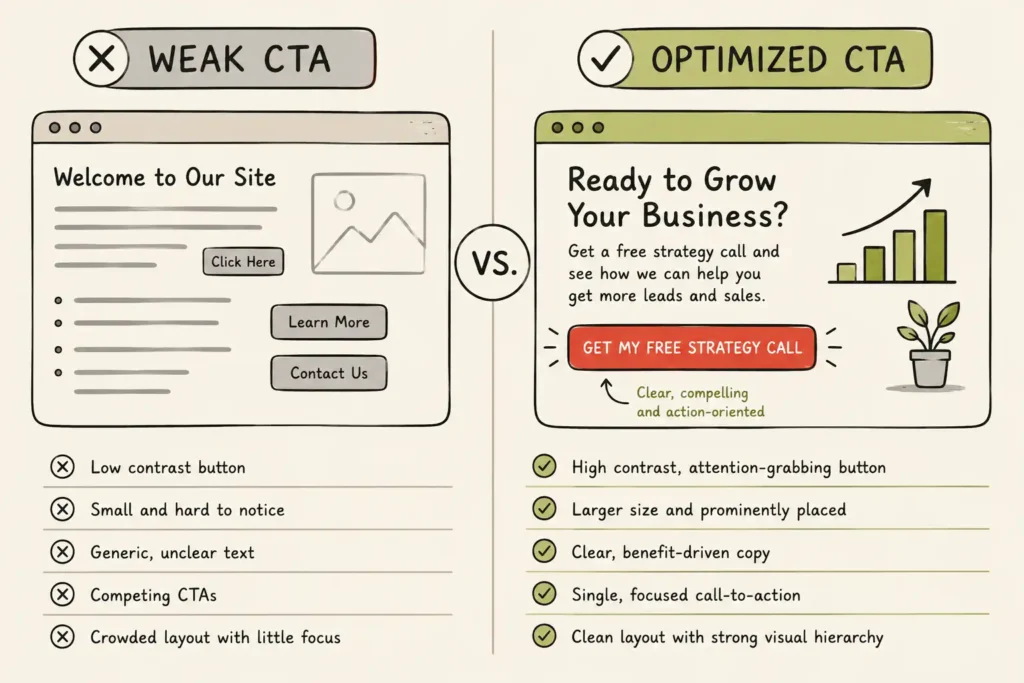
Use Action-Oriented Language
Strong CTA copy focuses on actions and outcomes.
Compare these examples:
| Generic CTA | Improved CTA |
|---|---|
| Submit | Request a Quote |
| Learn More | Get Started |
| Contact Us | Schedule a Consultation |
| Download | Get My Free Guide |
The strongest CTAs answer a simple question:
“What happens when I click this?”
The clearer the answer, the higher the likelihood of conversion.
The Power of Personalized CTAs
Personalization has become increasingly important as businesses seek to create more relevant user experiences.
CTA personalization may be based on:
- Industry
- Location
- Traffic source
- Previous website activity
- Customer journey stage
A roofing contractor visiting a website may respond better to:
- Get Your Roofing Website Review
than:
- Learn More About Our Services
Similarly, a returning visitor may respond better to:
- Continue Your Evaluation
than:
- Get Started
HubSpot’s CTA study demonstrated the value of this approach, finding personalized CTAs converted more than three times better than generic alternatives.
CTA Best Practices – Placement
Where a CTA appears can be nearly as important as what it says.
Above the Fold
Positioning a CTA near the top of a page allows highly motivated visitors to take immediate action.
This placement works particularly well for service businesses and consultation-driven websites.
Within Content
Placing CTAs naturally throughout content allows businesses to capture visitors while they are engaged.
This strategy is particularly effective in blog posts and educational resources.
After Demonstrating Value
Many visitors need reassurance before committing.
Positioning a CTA after explaining benefits, outcomes, or services often produces strong conversion rates because trust has already been established.
End-of-Page CTAs
Visitors who reach the bottom of a page have demonstrated significant interest.
An end-of-page CTA creates a natural opportunity to convert that interest into action.
Sticky CTAs
Persistent mobile buttons and sticky navigation CTAs can be highly effective because they remain visible throughout the browsing experience.
For appointment-driven businesses, these often improve accessibility and increase conversions.
Common CTA Mistakes That Hurt Conversions
Even well-designed websites frequently make avoidable CTA mistakes.
Too Many Competing Actions
Multiple primary CTAs create confusion.
Most pages should focus on one primary conversion goal.
Vague Messaging
Buttons labeled “Submit” or “Click Here” provide little motivation.
Specific actions consistently perform better.
Poor Mobile Experience
Mobile users now represent the majority of website traffic for many businesses.
Tiny buttons, difficult forms, and poor spacing often reduce conversion rates significantly.
Weak Visual Contrast
If visitors cannot quickly identify the CTA, they are less likely to engage with it.
Asking for Too Much Too Soon
Visitors may not be ready to schedule a consultation immediately.
Offering lower-commitment actions such as a guide, checklist, or assessment can often increase engagement.
Long Forms
Every additional field introduces friction.
Businesses should only request information necessary for the next step.
How CTA Optimization Impacts Business Growth
The financial impact of CTA optimization is often underestimated.
Consider a service business receiving:
- 5,000 website visitors per month
- 2% conversion rate
- 100 monthly leads
Improving CTA effectiveness increases conversions to 3%.
The result:
- 150 monthly leads
That’s an additional 50 leads every month.
Over one year, that equals 600 additional leads without increasing traffic.
If 20% of those leads become customers and the average project value is $2,500, the business generates an additional $300,000 in annual revenue.
The website received the same traffic.
The difference came from improving conversions.
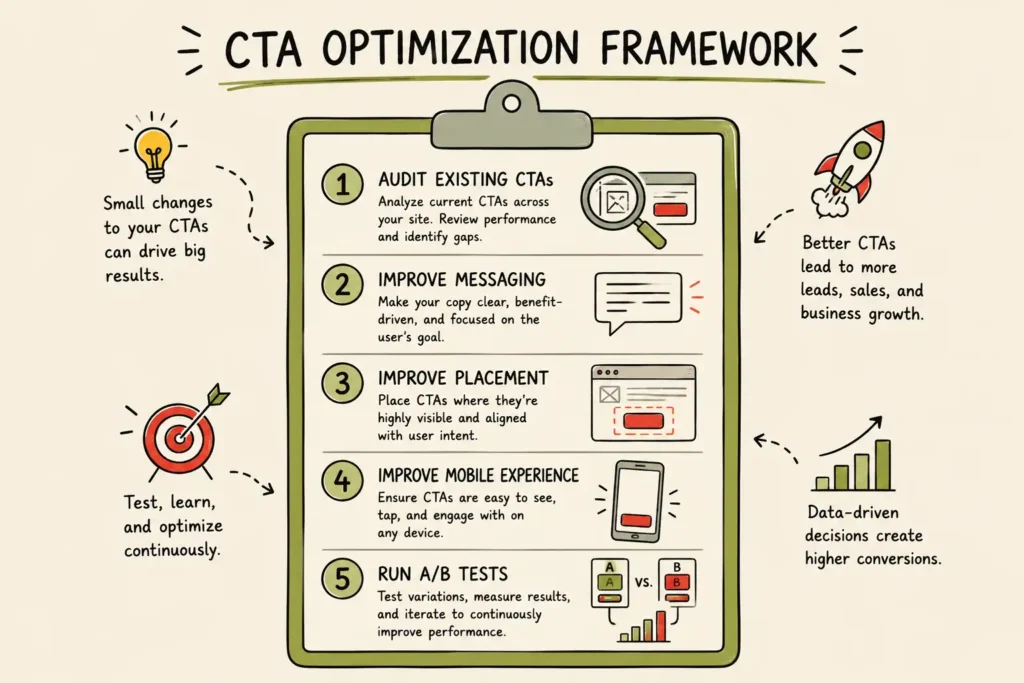
A Simple CTA Optimization Framework
Businesses looking to improve website conversions can follow a straightforward process:
1. Audit Existing CTAs
Identify every CTA on the website and determine whether it supports a clear business goal.
2. Define Conversion Goals
Each page should have one primary action.
3. Improve Messaging
Focus on outcomes, benefits, and clarity.
4. Improve Placement
Test different locations throughout the page.
5. Strengthen Visual Hierarchy
Increase contrast, spacing, and prominence.
6. Improve Mobile Usability
Ensure CTAs are easy to find and easy to tap.
7. Run A/B Tests
Test one variable at a time.
8. Measure Results
Track conversion rates, leads, revenue, and engagement metrics.
Conclusion
Calls to action are among the most important elements on any website because they sit at the exact point where interest becomes action.
Research from HubSpot, CXL, Stanford’s Fogg Behavior Model, behavioral economics studies from Kahneman and Tversky, and decades of usability research all point toward the same conclusion: people are more likely to take action when the next step is clear, relevant, visible, and easy to understand.
For businesses seeking growth, optimizing CTAs can produce meaningful improvements in lead generation, sales, and customer acquisition efficiency without increasing traffic or advertising spend.
Most businesses focus on generating more traffic. Research consistently shows that improving calls to action can often produce meaningful growth without increasing traffic at all.
If your website is attracting visitors but not generating the inquiries, appointments, or sales you expect, start by evaluating your calls to action. Small improvements in messaging, placement, and user experience can often create measurable business results.
We’re here to help
Turn Your Website Into A Growth Asset
Discover how Flexify Labs designs and builds websites that help businesses generate leads, support SEO, and create better customer experiences.