
One of the most common misconceptions about WordPress is that building a website requires a long list of expensive premium plugins.
In reality, many small business websites can operate successfully using mostly free plugins. While premium plugins certainly have their place, they’re often only necessary when a website requires advanced functionality, specialized integrations, or unique business features.
Understanding WordPress plugin costs starts with understanding what plugins actually do, when paid versions provide value, and when the free version is more than enough.
What Is a WordPress Plugin?
A WordPress plugin is a tool that adds functionality to your website.
Think of plugins like apps on your phone. WordPress provides the foundation of your website, while plugins allow you to extend its capabilities without custom development.
Plugins can add features such as:
- Contact forms
- Search engine optimization (SEO)
- Security enhancements
- Ecommerce functionality
- Appointment booking
- Performance optimization
- Email marketing integrations
- Membership systems
One of WordPress’s greatest strengths is the sheer number of available plugins, many of which offer robust free versions.
Do Most Websites Need Premium Plugins?
The short answer is no.
Many business websites can operate perfectly well using free plugins and standard WordPress functionality.
For example, a typical local business website may only need:
- Service pages
- Contact forms
- Basic SEO optimization
- Security protection
- Performance enhancements
All of these needs can often be addressed using free tools.
A landscaping company, photographer, consultant, restaurant, or local service provider may never need a large collection of premium plugins to operate effectively.
This is one reason WordPress can be surprisingly affordable compared to many website builders that charge recurring monthly fees for functionality that may never be used.
Free Plugins Have Improved Significantly
Years ago, free plugins often felt limited and incomplete.
Today, many plugin developers provide generous free versions that cover the needs of most website owners.
A good example is Rank Math SEO.
While Rank Math offers a premium version with advanced SEO features, many websites can achieve excellent optimization using the free version alone.
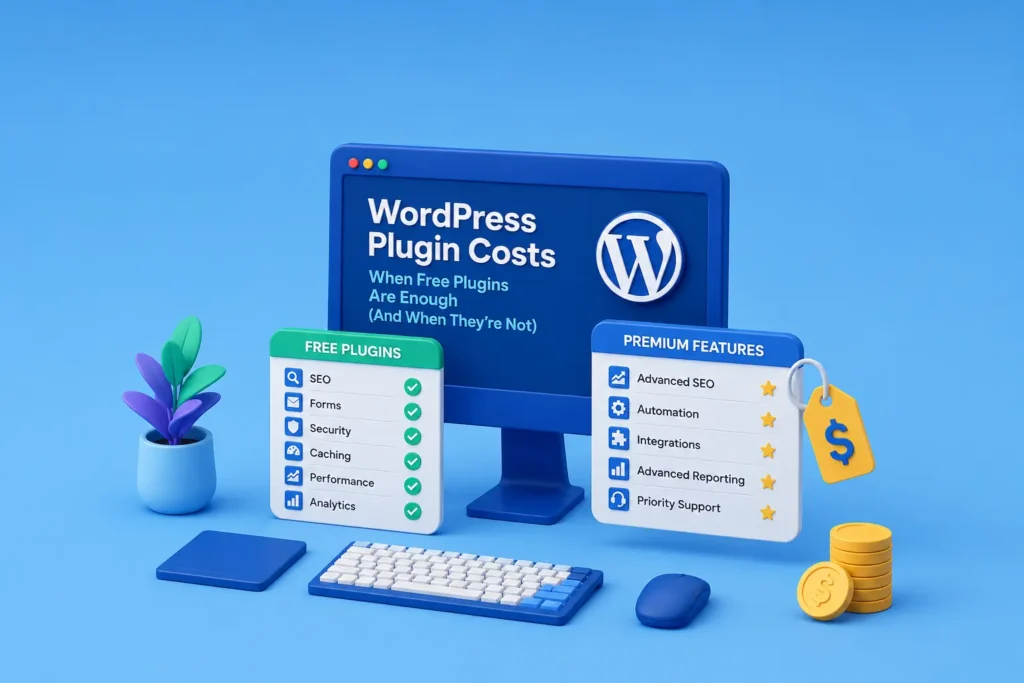
The same is true for many popular plugins across categories such as:
- SEO
- Forms
- Security
- Caching
- Image optimization
- Website analytics
For many websites, the free version provides everything necessary to launch, maintain, and grow a successful online presence.
What Are You Actually Paying For?
When a plugin offers a premium version, you’re typically paying for advanced functionality rather than basic functionality.
The premium version often includes features such as:
- Additional customization options
- Advanced reporting
- Automation tools
- Third-party integrations
- Ecommerce enhancements
- Membership capabilities
- Priority support
The free version usually handles the core functionality, while the premium version is designed for businesses with more complex requirements.
Typical WordPress Plugin Costs
Because many websites rely heavily on free plugins, WordPress plugin costs are often much lower than many people expect.
A small business website may spend:
| Website Type | Typical Annual Plugin Costs |
|---|---|
| Basic Service Website | $0–$100/year |
| Portfolio Website | $0–$100/year |
| Local Business Website | $0–$150/year |
| Ecommerce Website | $100–$500+/year |
| Membership Website | $200–$1,000+/year |
The key takeaway is that plugin expenses are usually driven by advanced business functionality, not by the basic operation of the website itself.
Many websites spend little or nothing on plugin licenses for years.
When Premium Plugins Make Sense
Premium plugins become valuable when they save time, automate workflows, or generate revenue.
Common examples include:
Ecommerce Websites
Online stores often benefit from premium functionality for:
- Product subscriptions
- Advanced shipping options
- Product reviews
- Inventory management
- Enhanced checkout experiences
Appointment-Based Businesses
Businesses that rely on scheduling may benefit from premium booking systems that automate reservations and reminders.
Membership Websites
If you’re selling courses, exclusive content, or subscriptions, premium membership plugins often become essential.
Growing Marketing Programs
Businesses investing heavily in lead generation, email marketing, or conversion optimization may benefit from premium integrations and automation tools.
When Premium Plugins Are Usually Unnecessary
Many website owners assume they need premium plugins simply because they exist.
In reality, they may never use the advanced features they are paying for.
Premium plugins are often unnecessary when:
- The website is primarily informational
- Contact forms meet business needs
- Basic SEO is sufficient
- There are no complex integrations
- The business is still validating its idea
- Traffic levels are relatively low
In these situations, free plugins can often provide everything required.
The Hidden Cost of Buying Plugins Too Early
A common mistake is purchasing premium plugins before there’s a clear need for their advanced features.
Website owners may end up paying annual renewal fees for functionality they rarely use.
Before purchasing any premium plugin, ask:
- What problem does this solve?
- Will I actually use the advanced features?
- Is the free version sufficient today?
- Will this help generate revenue or save meaningful time?
If the answer is unclear, it may be worth continuing with the free version until a real need emerges.
How Flexify Labs Approaches Plugin Selection
At Flexify Labs, our goal is not to load websites with as many plugins as possible.
Instead, we focus on selecting tools that provide genuine value while keeping long-term ownership costs reasonable.
Whenever practical, we prioritize:
- Reliable free plugins
- Lightweight website builds
- Minimal recurring expenses
- Scalable solutions that can grow over time
Premium plugins are recommended when they solve a specific business problem or provide functionality that free alternatives cannot reasonably deliver.
The result is a website that remains flexible, affordable, and easier to maintain.
Final Thoughts
When people hear about WordPress plugin costs, they often assume every website requires multiple premium subscriptions.
The reality is much simpler.
Many small business websites can operate effectively using mostly free plugins, with premium tools reserved for situations that require advanced functionality or specialized business features.
The best approach is to start with what your website actually needs today and only invest in premium plugins when there is a clear benefit.
In many cases, the free version may be all you need.